Google Business Profile Optimization Checklist 2026
Use this Google Business Profile optimization checklist 2026 to rank higher in local search, attract more leads, and outperform competitors in the map pack.

Google Business Profile Optimization Checklist 2026: The Complete Guide
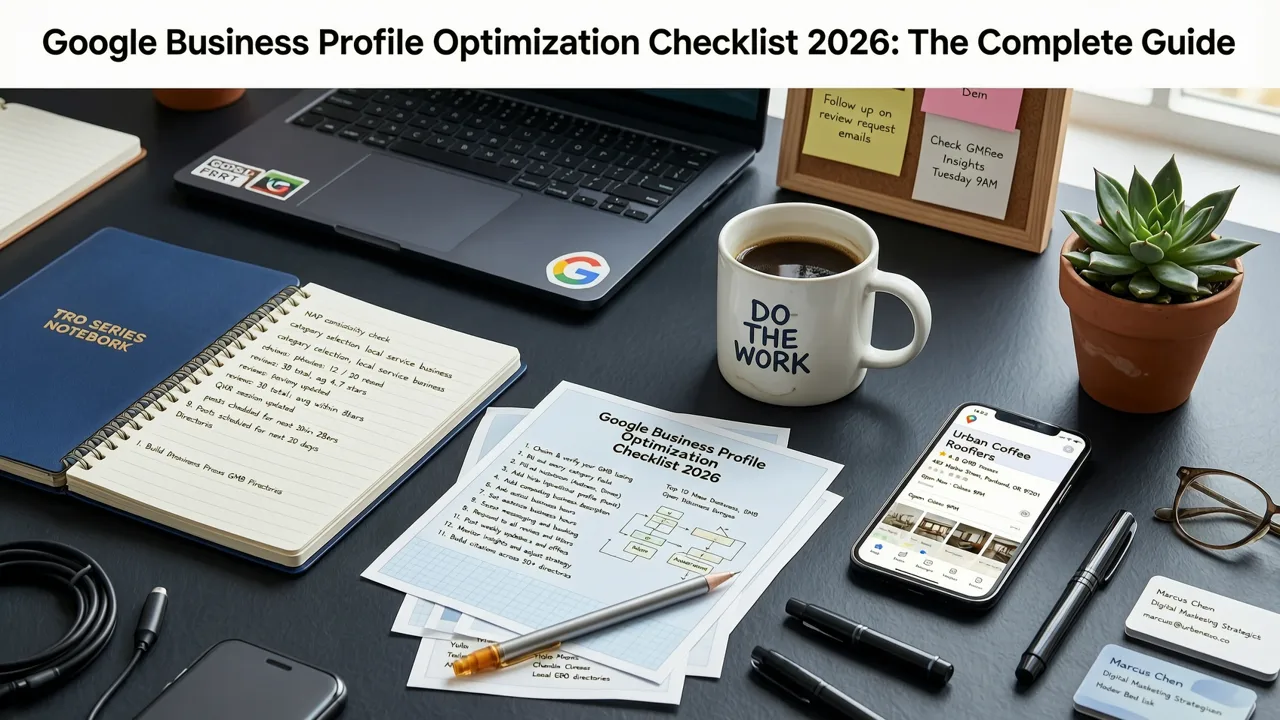
If you want to dominate local search in 2026, your Google Business Profile optimization checklist is the single most important tool in your marketing stack. A fully optimized profile increases your visibility in Google Maps, drives qualified phone calls and direction requests, and builds the trust signals that convert browsers into buyers.
This guide gives you a complete, step-by-step checklist to audit, optimize, and maintain your Google Business Profile (GBP) so you can capture more local traffic, earn more reviews, and grow revenue from organic search. Every tactic below reflects how Google's local algorithm works in 2026, including the latest changes to profile verification, AI-generated summaries, and review signals.
Why Your Google Business Profile Matters More in 2026
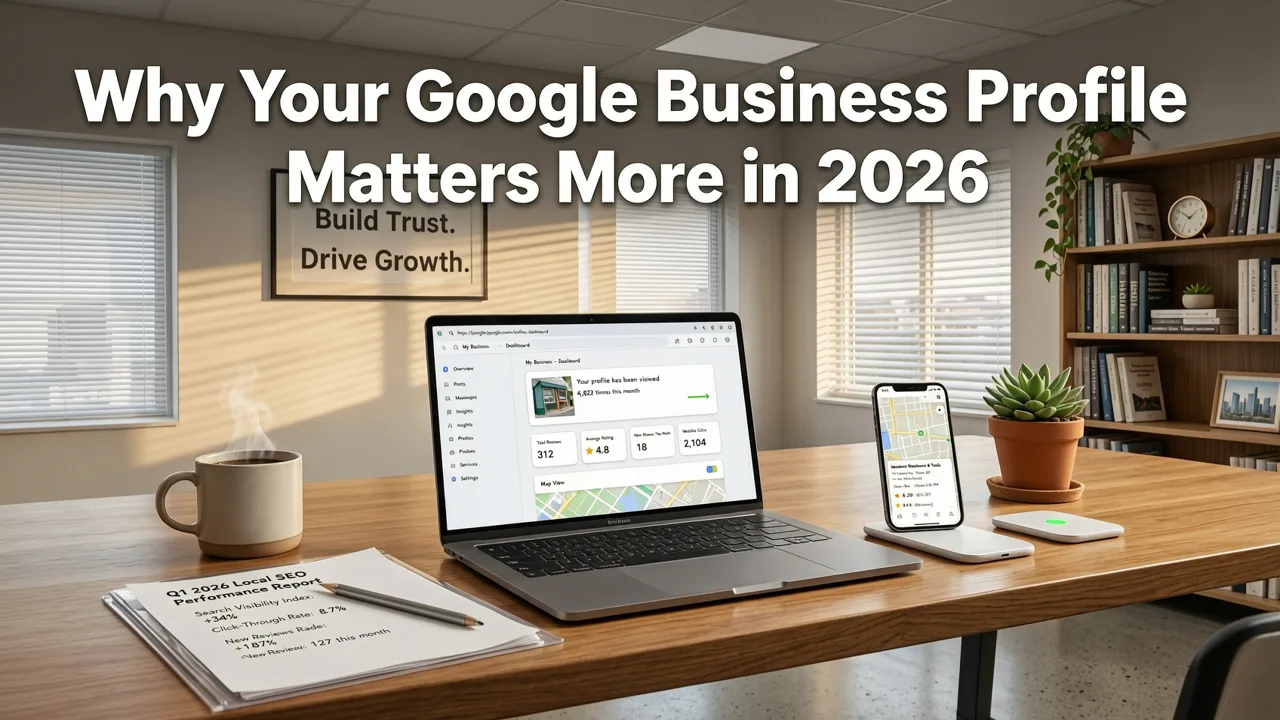
Google's local search ecosystem has evolved dramatically. In 2026, the search engine relies on a combination of profile completeness, review velocity, engagement signals, and entity-level relevance to rank businesses in the Local Pack and Local Finder. A half-filled profile simply cannot compete against competitors who treat their GBP as a living, breathing marketing channel.
Here is what makes GBP optimization critical right now:
- AI Overviews in local search: Google now pulls structured data directly from optimized profiles to answer local queries above the fold.
- Review sentiment analysis: Google's natural language models weigh the content of your reviews, not just star ratings.
- Visual engagement signals: Profiles with 360° photos, videos, and regular photo uploads earn significantly more direction requests.
- Q&A authority: Businesses that proactively seed and answer questions rank higher than those that leave the section empty.
- Service and product schema: Detailed service menus and product listings now feed directly into Google's knowledge panels.
If your website's technical SEO is already dialed in through tools like our Free SEO Audit Tool 2026, your local presence is the next growth lever to pull.
The Complete Google Business Profile Optimization Checklist 2026
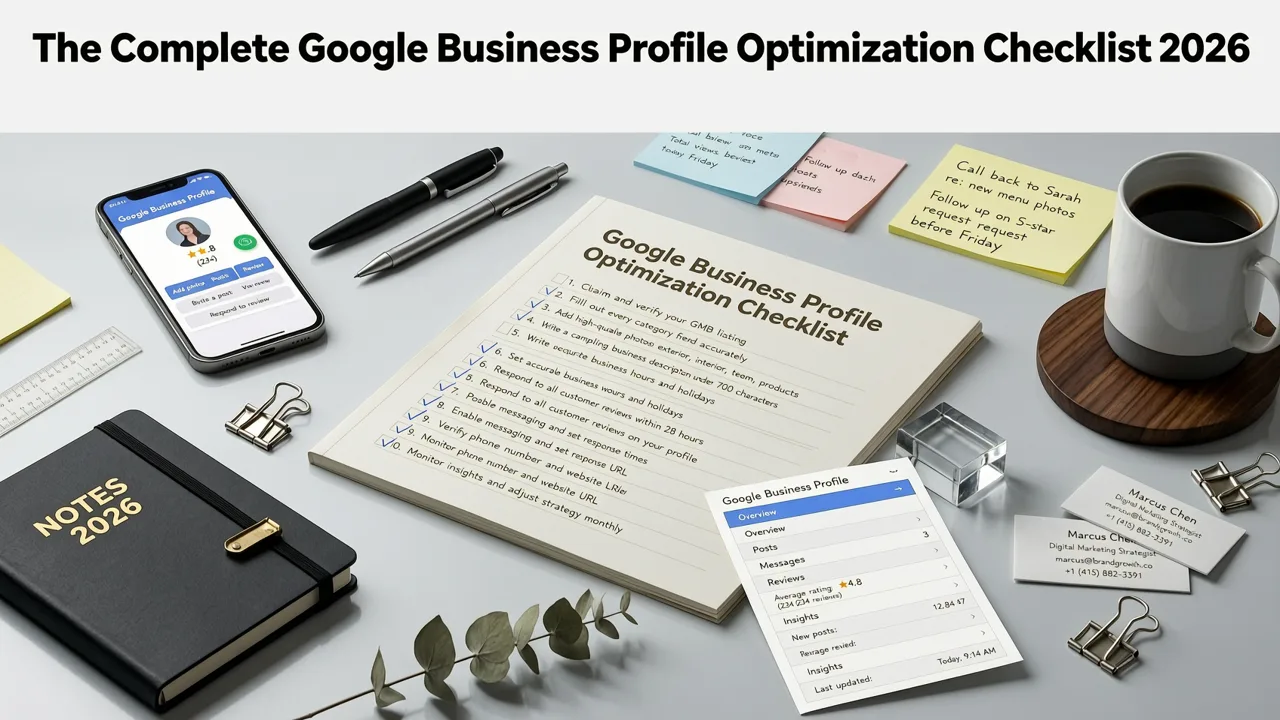
Below is the full checklist broken into seven categories. Work through each section in order, then revisit monthly to maintain your ranking momentum.
1. Profile Basics and Core Information
Accuracy in your core NAP (Name, Address, Phone) data is the foundation of local SEO. Google cross-references this information against your website, citations, and third-party directories.
- Business name: Use your real-world business name. Avoid keyword stuffing (e.g., "Bob's Plumbing - Best Plumber in Austin") as this violates Google's guidelines and risks suspension.
- Primary category: Choose the single most accurate category. This is the strongest ranking factor after relevance and distance.
- Secondary categories: Add up to 9 additional categories that genuinely reflect your services.
- Address: Ensure your street address matches your website footer and all citation sources exactly.
- Phone number: Use a local area code number when possible. Avoid toll-free numbers for local businesses.
- Website URL: Link to the most relevant page, not necessarily your homepage. A location-specific landing page often performs better.
- Business hours: Keep hours current, including special hours for holidays. Inaccurate hours generate negative user signals.
- Service areas: Define the cities and zip codes you serve. Be realistic; overextending dilutes relevance.
- Write in natural language and include your primary service keywords within the first 250 characters.
- Mention your service area, years in business, and any certifications or awards.
- Avoid URLs, phone numbers, or promotional language like "best" or "cheapest."
- Update seasonally to reflect current promotions or new service offerings.
- Select every applicable attribute: women-led, veteran-owned, LGBTQ+ friendly, wheelchair accessible, and so on. Attributes appear as badges in search results and influence click-through rate.
- Upload a high-resolution cover photo that represents your brand.
- Add interior, exterior, team, and product photos. Aim for at least 30 images total.
- Include 360° walkthrough videos for service-area businesses like plumbers, attorneys, and contractors.
- Post short-form video content (15–60 seconds) showcasing your services, customer testimonials, or behind-the-scenes footage.
- Refresh your photo library monthly. Remove outdated seasonal images and replace them with current ones.
- Geotag photos before uploading to reinforce your location relevance.
- Add every service you offer with a description, price (or price range), and estimated duration.
- For product-based businesses, upload your full catalog with images, descriptions, and direct links to purchase pages.
- Use keyword-rich but natural service descriptions. Include long-tail variations your customers search for.
- Highlight your top 5 services as "featured" so they appear prominently on your profile.
- Keep pricing current. Outdated pricing creates friction and reduces trust.
- Respond to every review within 24 hours. Thank positive reviewers and address negative feedback professionally.
- Use review response templates that include your business name and service keywords naturally.
- Implement a systematic review request process via email, SMS, or QR codes at your location.
- Aim for a minimum 4.5-star average with at least 50 reviews for competitive local markets.
- Encourage reviewers to mention specific services they used. This builds semantic relevance for those terms.
- Monitor and report fake or spam reviews through Google's removal tool.
- Publish at least one post per week. Mix between event posts, offer posts, and update posts.
- Include a clear call-to-action in every post: "Call now," "Book online," "Learn more."
- Use high-quality images or graphics with each post. Text-only posts receive significantly less engagement.
- Pin your most important offer or announcement to the top of your profile.
- Share blog content, seasonal promotions, and community involvement to build topical authority.
- Seed your Q&A section with 10–15 common questions and detailed answers. You can post questions from your own account.
- Monitor and respond to new questions within 24 hours.
- Enable messaging and set up auto-responses with your hours and a call-to-action.
- Set your response time expectation to under one hour during business hours.
- Use the accessibility attributes to highlight ADA compliance, parking availability, and other features that matter to local searchers.
- Publishing local content on your website that references the same services and location terms as your GBP.
- Building citations on authoritative directories that match your GBP data exactly.
- Earning backlinks from local news sites, chambers of commerce, and industry associations. Use a free backlink checker tool to monitor your local link profile and identify opportunities.
- Keyword stuffing your business name.
- Using a virtual office or PO box as your address.
- Creating duplicate profiles for the same location.
- Purchasing fake reviews or using review gating software.
- Misrepresenting your service area or business hours.
- Search views: How many times your profile appeared in search results.
- Map views: How many times your profile appeared in Google Maps.
- Website clicks: Direct traffic from your profile to your website.
- Direction requests: Users asking for directions to your location.
- Phone calls: Calls initiated directly from your profile.
- Photo views: Engagement with your visual content.
- Booking clicks: Actions taken on your booking or appointment links.
2. Business Description and Attributes
Your business description is a 750-character opportunity to communicate your unique value proposition. Google uses this text to understand your services and match user intent.
3. Photos, Videos, and Visual Content
Visual content is one of the most underused ranking factors in 2026. Profiles with at least 25 high-quality photos receive 42% more direction requests and 35% more website clicks than those with fewer than 10.
4. Services, Products, and Menu Optimization
Google now treats your service and product listings as structured data that feeds directly into search results. Detailed listings improve both rankings and conversion rates.
5. Reviews and Reputation Management
Reviews remain a top-three local ranking factor in 2026. Google's algorithms now analyze review text for semantic relevance, sentiment, and recency.
6. Posts, Updates, and Engagement Signals
Google Business Posts function as micro-content that signals activity and relevance. Active profiles consistently outperform dormant ones in local rankings.
7. Q&A, Messaging, and Accessibility
The Q&A section is frequently overlooked but carries surprising ranking weight. Unanswered questions signal poor customer service to Google's algorithm.
Advanced Google Business Profile Tactics for 2026
Once your profile is fully optimized with the checklist above, you can layer in advanced strategies to widen your competitive gap.
Leverage AI-Powered Insights
Google's Business Profile dashboard now surfaces AI-generated insights about customer behavior, search queries, and competitor comparisons. Review these insights weekly to identify content gaps and adjust your posting strategy accordingly.
Build Entity-Level Authority
Your GBP does not exist in isolation. Google connects your profile to your website, social profiles, and third-party mentions as a unified entity. Strengthen this connection by:
Avoid Common GBP Violations
Google's enforcement of profile guidelines has tightened in 2026. Avoid these common mistakes that trigger suspensions:
If you are considering paid link strategies to support your local SEO, understand the risks involved. Our guide on buying backlinks safely in 2026 covers what works and what puts your rankings at risk.
Google Business Profile Optimization Checklist: Quick Reference Table
Use this table as a monthly audit tool to ensure nothing falls through the cracks.
| Checklist Item | Frequency | Priority | Impact |
|---|---|---|---|
| Verify NAP accuracy across all platforms | Monthly | Critical | High |
| Update primary and secondary categories | Quarterly | Critical | High |
| Upload new photos and videos | Monthly | High | Medium-High |
| Publish Google Business Posts | Weekly | High | Medium |
| Respond to all reviews | Daily | Critical | High |
| Seed and answer Q&A questions | Monthly | Medium | Medium |
| Update services and product listings | Quarterly | High | Medium-High |
| Review AI insights and adjust strategy | Weekly | Medium | Medium |
| Audit citations for consistency | Quarterly | High | High |
| Check for profile violations or warnings | Monthly | Critical | High |
How to Measure Your Google Business Profile Performance
Optimization without measurement is guesswork. Track these key performance indicators to quantify the impact of your GBP work:
Compare these metrics month over month. A well-optimized profile should show consistent growth across all categories within 60 to 90 days of implementing this checklist.
Conclusion: Start Optimizing Your Google Business Profile Today
Your Google Business Profile is the most valuable piece of real estate in local search. In 2026, the businesses that treat their GBP as a dynamic, regularly updated marketing channel will capture the majority of local search traffic, phone calls, and foot traffic in their markets. Use this Google Business Profile optimization checklist 2026 as your roadmap, audit your profile against every item, and commit to monthly maintenance. The rankings and revenue will follow.
Ready to take your local SEO to the next level? Start with a comprehensive website audit using our Free SEO Audit Tool 2026 to ensure your on-site foundation supports your local optimization efforts.
Related resources
Frequently Asked Questions
How often should I update my Google Business Profile in 2026?
You should update your Google Business Profile at least weekly with new posts and photos, respond to reviews daily, and perform a full audit of your core information, categories, and service listings every quarter. Consistent activity signals relevance to Google's local algorithm.
What is the most important ranking factor for Google Business Profile in 2026?
The most important factors are relevance (accurate categories, services, and description), proximity (distance from the searcher), and prominence (review count, rating, photo engagement, and website authority). Review sentiment and profile completeness have gained significant weight in 2026.
Can I keyword stuff my Google Business Profile business name?
No. Keyword stuffing your business name violates Google's guidelines and can result in profile suspension. Use only your real-world business name as it appears on your storefront and legal documents.
How many photos should I upload to my Google Business Profile?
Aim for a minimum of 25 to 30 high-quality photos covering your exterior, interior, team, products, and services. Profiles with 25 or more photos receive significantly more direction requests and website clicks than those with fewer images.
Do Google Business Posts still impact local rankings in 2026?
Yes. While posts do not directly influence rankings as a standalone factor, they drive engagement signals such as clicks, calls, and direction requests. Active posting also signals to Google that your business is current and relevant, which supports overall local ranking performance.
Related Articles


Explore more practical SEO Services and appraisal guides.
View all articles