Local SEO Checklist for Small Business (2026 Edition)
Use this local SEO checklist for small business owners to rank higher in 2026. Optimize Google Business Profile, citations, reviews, and on-page signals for local search.

Why the Local SEO Checklist for Small Business Matters More Than Ever in 2026
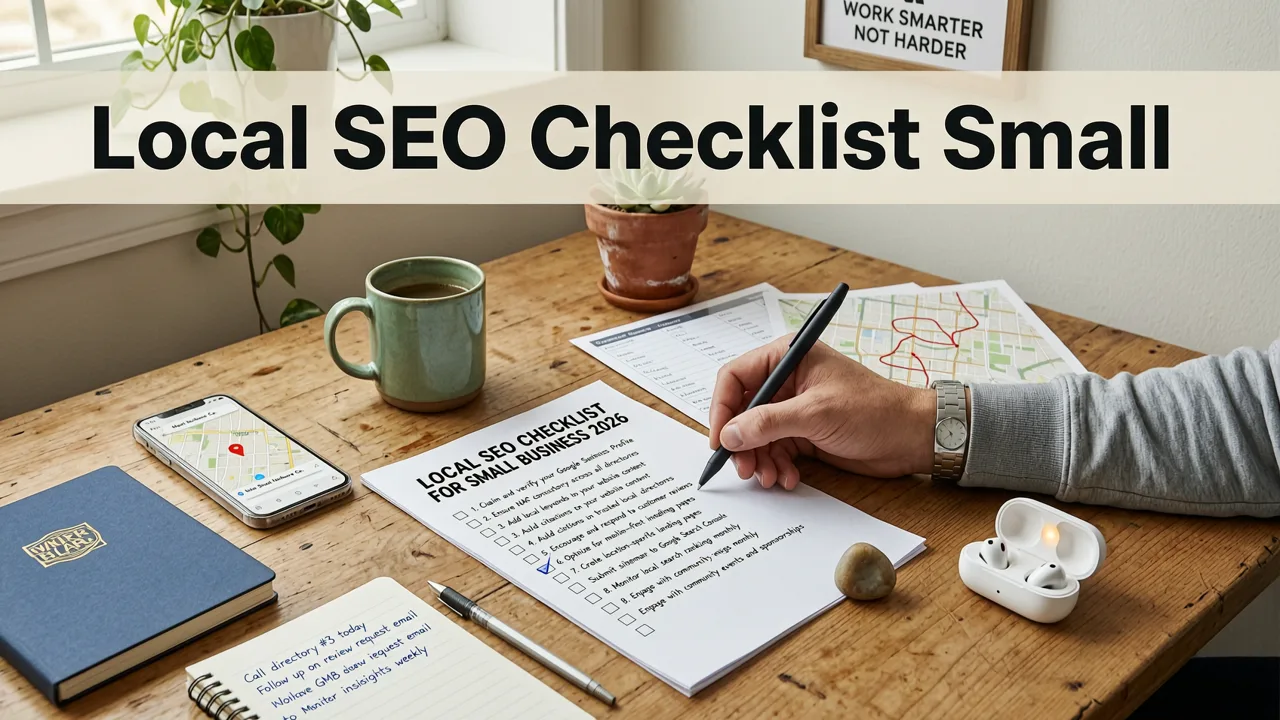
If you run a small business, your next customer is almost certainly searching on a phone right now — and Google is deciding whether to show you or your competitor. This local SEO checklist for small business gives you a complete, step-by-step roadmap to claim that visibility in 2026, from Google Business Profile optimization to review velocity and schema markup.
Local search has evolved dramatically. Google's AI Overviews now surface local packs inline with traditional results, voice search queries continue to climb, and map-pack rankings weigh signals like review sentiment, engagement, and proximity more heavily than ever. The good news: most small businesses still aren't executing the fundamentals well. If you follow this checklist, you'll outpace the majority of competitors in your market.
Whether you're a plumber, dentist, attorney, restaurant, or boutique retailer, this guide covers every action item you need — in priority order — to dominate local search results this year.
Phase 1: Google Business Profile Optimization
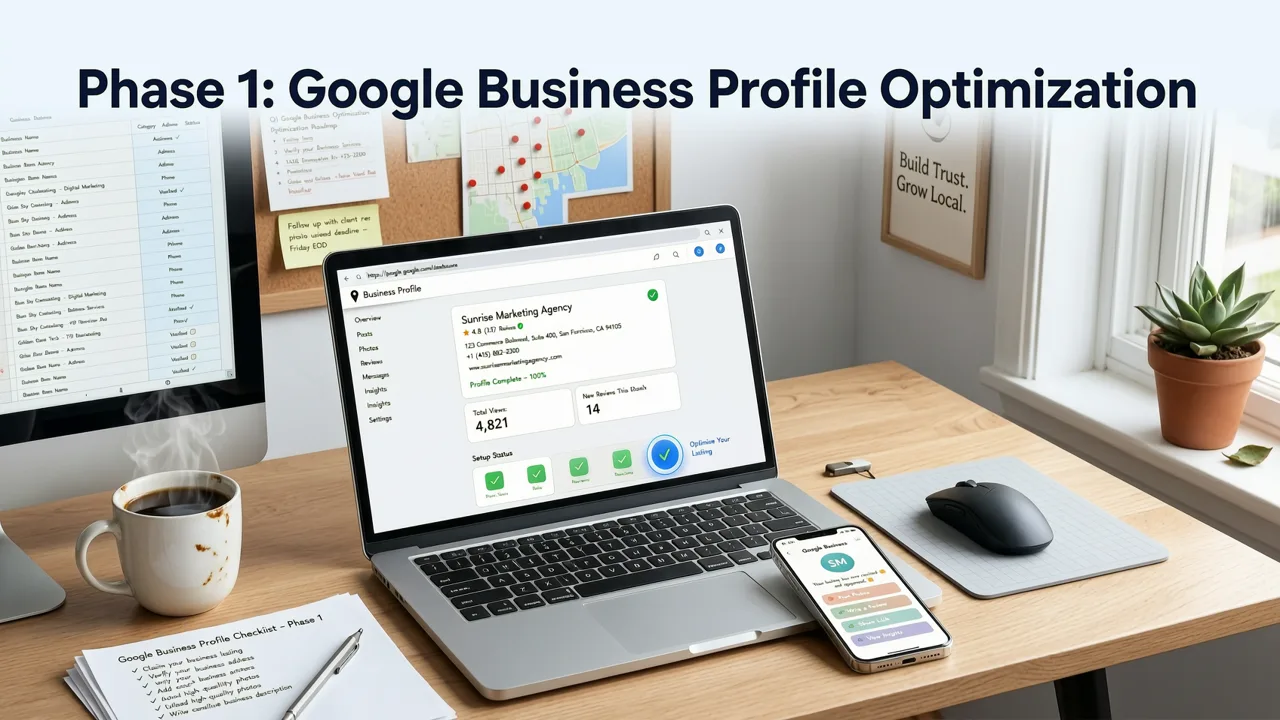
Your Google Business Profile (GBP) is the single most influential ranking factor for local pack results. Treat it like a second homepage.
Claim and Verify Your Profile
Ensure your business is claimed and verified through Google Business Profile. If you manage multiple locations, use the bulk verification or group management features. Unverified listings cannot rank in the map pack.
Complete Every Field
Fill out every available attribute: business name, address, phone number, website URL, hours (including special hours for holidays), business description, categories (primary and secondary), services or products, and accessibility attributes. Google uses these fields to match searcher intent.
Choose the Right Primary Category
Your primary category is the strongest classification signal. Be specific — "Personal Injury Attorney" outperforms "Lawyer" for relevant queries. Add secondary categories to capture adjacent searches.
Add High-Quality Photos and Videos
Profiles with 100+ photos receive significantly more direction requests and clicks. Upload exterior shots, interior photos, team images, product photos, and short video walkthroughs. Refresh media monthly to signal an active profile.
Use Google Posts Strategically
Publish Google Posts weekly — rotate between offers, events, product highlights, and updates. Posts increase profile engagement, which correlates with improved local rankings.
Enable Messaging and Q&A
Turn on messaging for direct inquiries. Pre-populate the Q&A section with your most common questions and answers rather than waiting for users to ask them.
Phase 2: NAP Consistency and Citation Building
Your Name, Address, and Phone number (NAP) must be identical across every platform where your business appears. Inconsistencies confuse search engines and erode trust signals.
Audit Existing Citations
Use a citation audit tool to scan directories like Yelp, Yellow Pages, Bing Places, Apple Maps, Facebook, industry-specific directories, and local chambers of commerce. Document any discrepancies in formatting, suite numbers, or phone number variations.
Fix and Standardize
Correct every inconsistency. Decide on a single formatting standard (e.g., "123 Main St. Suite 200" vs. "123 Main Street, Ste. 200") and apply it everywhere.
Build New Citations on High-Authority Platforms
Focus on platforms that carry real weight: Google, Apple Maps, Bing, Facebook, Yelp, BBB, and niche directories relevant to your industry. Quality matters far more than quantity in 2026.
| Platform | Priority | Notes |
|---|---|---|
| Google Business Profile | Critical | Primary local ranking driver |
| Apple Maps Connect | High | Default for all iOS users |
| Bing Places | High | Often overlooked, still drives traffic |
| Facebook Business Page | High | Strong domain authority, social signals |
| Yelp | Medium-High | Key for restaurants, services, retail |
| Industry-Specific Directories | Medium | Avvo, Healthgrades, Houzz, etc. |
| Local Chamber of Commerce | Medium | Strong geographic relevance signal |
Phase 3: On-Page Local SEO Signals
Your website must clearly communicate to search engines where you are, what you do, and who you serve. For a deeper dive, review our On-Page SEO Best Practices 2026 guide.
Optimize Title Tags and Meta Descriptions
Include your city or region and primary service in every page title. Example: "Emergency Plumber in Austin, TX | 24/7 Service | Your Business Name." Keep meta descriptions under 155 characters with a clear call to action.
Create Dedicated Location Pages
If you serve multiple cities or neighborhoods, build a unique location page for each. Avoid thin, duplicate content — each page should include specific information about serving that area, local landmarks, testimonials from that community, and embedded maps.
Add LocalBusiness Schema Markup
Implement structured data using Schema.org vocabulary. At minimum, mark up your business name, address, phone, geo-coordinates, opening hours, price range, and aggregate ratings. This helps Google display rich results and understand your business context. Reference Google Search Central documentation for the latest implementation standards.
Embed a Google Map on Your Contact Page
An embedded map reinforces your physical location to search engines and improves user experience. Pair it with clear driving directions and parking information.
Include Local Content and Community References
Mention local events, sponsorships, partnerships, and neighborhood-specific content. This builds topical relevance and demonstrates genuine community connection.
Phase 4: Review Generation and Reputation Management
Reviews influence both rankings and conversion rates. In 2026, Google weighs review velocity, sentiment, and response behavior as ranking signals.
Implement a Proactive Review Request System
Don't wait for customers to leave reviews. After every positive interaction, send a personalized request via SMS or email with a direct link to your Google review form. Automate this process through your CRM.
Respond to Every Review
Respond to all reviews — positive and negative — within 24 to 48 hours. Thank reviewers, address concerns professionally, and demonstrate that your business is active and engaged. Responses signal to Google that you value customer feedback.
Monitor Review Sentiment
Track recurring themes in reviews. If multiple customers mention slow response times, that's an operational issue to fix. Positive sentiment patterns around specific services can inform your content strategy.
Never Buy or Incentivize Reviews
Google's policies strictly prohibit incentivized or fake reviews. Violations can result in profile suspension. Focus on genuine, organic review generation.
Phase 5: Local Link Building
Local backlinks from community-relevant websites strengthen your geographic authority. This complements the broader strategies outlined in our SEO for Small Business 2026 resource.
Sponsor Local Events and Organizations
Sponsor little league teams, charity runs, school events, or community festivals. These sponsorships typically earn a link from the organization's website — a powerful local relevance signal.
Get Featured in Local Media
Pitch stories to local newspapers, blogs, and TV stations. Community involvement, unique business milestones, and expert commentary on local issues all generate coverage and links.
Join Local Business Associations
Chamber of Commerce membership, Better Business Bureau accreditation, and industry-specific local groups all provide high-quality local citations and backlinks.
Create Locally Relevant Content
Publish blog posts about local topics: "Best Neighborhoods in [City] for First-Time Homebuyers," "A Guide to [City]'s Farmers Markets," or "How [Local Regulation] Affects [Your Industry]." This attracts local links and demonstrates community expertise.
Phase 6: Technical Local SEO Foundations
Ensure Mobile-First Performance
Over 60% of local searches happen on mobile devices. Your site must load in under 2.5 seconds, feature tap-friendly buttons, and display information without requiring horizontal scrolling. Test with Google's PageSpeed Insights and Core Web Vitals reports.
Implement HTTPS Everywhere
Security is a baseline ranking factor. Ensure your SSL certificate is valid and all pages redirect to HTTPS.
Create a Clean XML Sitemap
Include all location pages, service pages, and key content in your sitemap. Submit it through Google Search Console.
Fix Crawl Errors
Regularly check Google Search Console for 404 errors, redirect chains, and indexing issues. Fix them promptly to ensure Google can access and rank your pages.
Phase 7: Local Keyword Research and Content Strategy
Understanding what your local customers search for drives every other tactic on this checklist. If you need a refresher on research fundamentals, our keyword research guide for beginners covers the full workflow.
Identify Local Keyword Variations
Map out searches that include your city, neighborhood, county, and "near me" modifiers. Tools like Google Keyword Planner, Ahrefs, and Semrush reveal local search volume and competition levels.
Target Service + Location Combinations
"Emergency dentist in Riverside," "best Mexican restaurant near downtown," "HVAC repair [city name]" — these compound queries represent high-intent local searchers ready to convert.
Build Content Around Local Questions
Answer questions your customers actually ask: "How much does [service] cost in [city]?" "What's the best time to visit [local attraction]?" "Do I need a permit for [project] in [county]?" This positions your business as the local authority.
Phase 8: Tracking, Measurement, and Ongoing Optimization
Set Up Local Rank Tracking
Monitor your map pack positions and local organic rankings for target keywords across multiple zip codes. Tools like BrightLocal, Whitespark, and Moz Local provide geo-grid tracking that shows ranking variation by proximity.
Track GBP Insights Metrics
Monitor search queries that trigger your profile, direction requests, phone calls, website clicks, and photo views. These metrics reveal what's working and where to improve.
Measure Conversion by Source
Use call tracking numbers, UTM parameters, and CRM attribution to connect local SEO activity to actual revenue. This justifies continued investment and identifies your highest-performing channels.
Schedule Quarterly Audits
Revisit this checklist every 90 days. Local SEO is not a set-and-forget discipline. Algorithms change, competitors adapt, and your business evolves. Regular audits keep you ahead.
Your Local SEO Checklist Summary
Here's a condensed version of every action item in this guide:
- Claim, verify, and fully optimize your Google Business Profile
- Publish weekly Google Posts and upload fresh photos monthly
- Audit and fix NAP consistency across all citations
- Build citations on high-authority local and industry directories
- Optimize title tags and meta descriptions with local keywords
- Create unique, content-rich location pages for each service area
- Implement LocalBusiness schema markup
- Launch a systematic review generation program
- Respond to every review within 48 hours
- Earn local backlinks through sponsorships and community involvement
- Publish locally relevant blog content monthly
- Ensure mobile-first site performance and Core Web Vitals compliance
- Track local rankings with geo-grid tools
- Measure conversions and attribute revenue to local SEO channels
- Audit and refresh your strategy quarterly
Final Thoughts: Local SEO Is a Competitive Advantage
Most small businesses treat local SEO as an afterthought. They claim their Google Business Profile, forget about it, and wonder why competitors rank above them. The businesses that win in local search are the ones that execute consistently across every item on this checklist.
Local SEO isn't complicated — but it does require discipline, consistency, and a willingness to adapt as search evolves. If you'd like expert help implementing this checklist or want a comprehensive audit of your current local presence, our team specializes in helping small businesses dominate their local markets. If you're also evaluating what professional SEO support costs, our SEO agency pricing guide breaks down realistic budgets for 2026.
Start with Phase 1 this week. By the end of the quarter, you'll see measurable improvements in your local search visibility, phone calls, and foot traffic. Your next customer is searching right now — make sure they find you.
Frequently Asked Questions
What is the most important factor for local SEO in 2026?
Your Google Business Profile is the single most important local SEO factor. A fully optimized, verified, and actively maintained GBP — with accurate information, quality photos, regular posts, and strong reviews — drives the majority of your local pack visibility and map rankings.
How long does it take to see results from local SEO?
Most small businesses see measurable improvements in local search visibility within 60 to 90 days of implementing a comprehensive local SEO strategy. Significant ranking gains and increased lead volume typically materialize within 3 to 6 months, depending on competition and market size.
How many Google reviews do I need to rank in the local pack?
There is no fixed number, but businesses with 20+ reviews and an average rating above 4.0 stars consistently outperform competitors with fewer reviews. Review velocity (new reviews per month), review sentiment, and owner responses all influence rankings alongside review count.
Should I create separate location pages for every city I serve?
Yes, if you genuinely serve those areas and can create unique, valuable content for each page. Avoid thin or duplicate location pages — each should include specific details about serving that community, local testimonials, embedded maps, and area-specific service information.
What is LocalBusiness schema markup and why does it matter?
LocalBusiness schema is structured data code added to your website that tells search engines your business name, address, phone number, hours, coordinates, and ratings. It helps Google display rich results, understand your business context, and confirm the accuracy of your local information.
Related Articles


Explore more practical SEO Services and appraisal guides.
View all articles