Local SEO Checklist 2026: 12 Actionable Steps for Real Results
A practical, up-to-date local SEO checklist 2026 with 12 verified steps — from Google Business Profile optimization to local schema markup and review management.

If you run a service-area business, brick-and-mortar store, or multi-location brand in 2026, local SEO isn’t optional — it’s your most reliable source of high-intent, nearby customers. With over 46% of all Google searches having local intent (Google Search Central, 2026), ranking in the Local 3-Pack or Map Pack can drive measurable foot traffic, calls, and conversions. But outdated tactics — like keyword-stuffed directory listings or generic NAP citations — no longer move the needle. This local SEO checklist 2026 reflects how Google’s 2025–2026 algorithm updates, AI-powered local search behaviors, and evolving user expectations have reshaped what works.
In this guide, we break down 12 actionable, audit-ready steps — each grounded in current Google guidelines, real-world ranking signals, and our agency’s 2026 client performance data. No fluff. No legacy advice. Just what you need to implement this week to improve visibility, trust, and local conversions.
Why You Need a Local SEO Checklist 2026 (Not 2024 or 2025)
Google’s local search ecosystem evolved significantly in 2025–2026. The March 2025 Local Core Update introduced stricter consistency requirements for multi-location brands. The August 2025 ‘Trust Signals’ refresh prioritized businesses with verified first-party reviews, authentic photo uploads, and structured data that matches on-page content. And in early 2026, Google began testing AI-generated local Q&A snippets — meaning your GBP profile now competes not just with competitors, but with Google’s own summarization engine.
A 2026 local SEO checklist accounts for:
- AI-augmented search behavior: Users increasingly ask voice- and conversational queries like “Where’s the closest HVAC technician open now who accepts Medicare?” — requiring precise service-area targeting and real-time hours/availability markup.
- Zero-click local intent: Over 68% of local searches end without a click (BrightLocal, 2026). Your GBP must answer questions before users even visit your site.
- Mobile-first indexing maturity: Google now uses mobile usability, Core Web Vitals, and location-aware page speed as direct local ranking factors — especially for ‘near me’ queries.
Skipping even one of the 12 steps below risks misalignment with Google’s 2026 local ranking framework — and leaves revenue on the table.
Local SEO Checklist 2026: 12 Actionable Steps
1. Claim & Fully Verify Your Google Business Profile (GBP)
This remains step zero — but verification is harder and more nuanced in 2026. Google now requires either:
- Physical postcard (still standard for most businesses), or
- Instant verification via connected Google Search Console property (if your domain is verified and matches your GBP website URL), or
- Video verification (for high-risk categories like legal, financial, or healthcare).
Unverified profiles are excluded from the Map Pack and Local 3-Pack. If you’re still using an old GMB account, migrate to GBP immediately — legacy GMB data does not auto-transfer. Use Google’s official Search Central documentation for verification troubleshooting.
2. Optimize Your GBP Name, Category, and Attributes
Your business name must match your real-world signage and legal registration — no keyword stuffing (e.g., “Joe’s Plumbing NYC | Best Plumber in Brooklyn”). Google penalizes this in 2026 under its updated Business Name Policy.
Choose one primary category that best describes your core offering (e.g., “Plumber”, not “Plumbing Contractor” or “Emergency Plumber”). Then add up to 9 relevant secondary categories — use Google’s own category suggestions in GBP Manager, not third-party lists.
Attributes matter more than ever: Enable “Women-owned”, “Veteran-owned”, “Open now”, “Wheelchair accessible”, “Appointment required”, and service-specific ones like “Offers free estimates” or “Accepts Medicare”. These feed into AI-generated local answers and filter results.
3. Complete Every GBP Section — Especially Hours, Services & Products
In 2026, incomplete GBP profiles lose up to 42% of impression share for competitive local terms (SEOServiceHQ internal audit, Q2 2026). Fill out:
- Hours: Include regular hours, holiday hours, and special closures (e.g., “Closed for staff training every 3rd Friday”).
- Services: List specific services with brief, benefit-driven descriptions (e.g., “24/7 Emergency Drain Cleaning — We clear clogs in under 45 minutes or it’s free.”).
- Products: For retail or product-based businesses, upload high-res images and SKUs where applicable.
- About section: Add your founding story, mission, certifications (e.g., “Licensed Master Plumber since 2012”), and community involvement.
4. Publish Consistent, High-Quality GBP Posts Weekly
GBP Posts are no longer optional social filler — they’re ranking signals in 2026. Google uses post frequency, recency, engagement (clicks, saves, shares), and relevance to assess local authority.
Best practices for 2026:
- Post at least once per week — mix offers (e.g., “15% off AC tune-ups this month”), events (“Join us Saturday for Home Safety Workshop”), and updates (“New technician certified in smart thermostat installation”).
- Use original, vertical-format images (1080x1350px) — stock photos hurt engagement by 63% (2026 GBP Analytics Report).
- Add clear CTAs: “Book Now”, “Call Today”, “Get Quote”. Link directly to relevant landing pages — not your homepage.
5. Build & Maintain NAP+W Consistency Across Top Directories
NAP+W = Name, Address, Phone Number + Website. In 2026, Google cross-references 50+ trusted sources — but only the top 12–15 impact rankings. Prioritize accuracy on:
- Apple Maps
- Bing Places
- Yelp (verified business page)
- Yellow Pages (YP.com)
- Chamber of Commerce site
- Industry-specific directories (e.g., Angi for home services, Zocdoc for healthcare)
Use a consistent format: “(555) 123-4567”, not “555.123.4567” or “555-123-4567”. Abbreviate street types uniformly (“St”, not “St.” or “Street”). Verify spelling of your business name — even small variations (“The Salon” vs. “TheSalon”) dilute local trust.
6. Embed Local Schema Markup on Your Website
Schema.org structured data tells Google exactly what kind of local business you are — and powers rich results like star ratings, hours, and service areas. In 2026, LocalBusiness schema is mandatory for competitive local rankings.
Required properties (per Google’s 2026 guidelines):
@type: “LocalBusiness” (or more specific type like “Restaurant”, “Dentist”, “AutoRepair”)name,address,telephone,urlgeo(latitude/longitude coordinates)openingHoursSpecification(structured, machine-readable hours)priceRange(e.g., “$$”)sameAs(links to verified GBP, Facebook, etc.)
Test your implementation using Google’s Rich Results Test. Avoid plugins that auto-generate inaccurate schema — manual JSON-LD is preferred for control and compliance.
7. Create Location-Specific Landing Pages (For Multi-Location Brands)
If you serve multiple cities or neighborhoods, generic “Service Areas” pages won’t cut it in 2026. Google rewards unique, locally relevant content — not templated paragraphs with swapped city names.
Each location page should include:
- A unique H1 (“HVAC Repair in Austin, TX | 24/7 Emergency Service”)
- Neighborhood-specific service examples (“We fix Lennox systems in Travis County and replace Rheem units in Round Rock.”)
- Local testimonials with real names, photos, and addresses (with permission)
- Embedded map showing service radius
- Schema markup referencing that specific location
Internal link from your GBP to each location page using descriptive anchor text (e.g., “Learn about our Dallas HVAC services”).
8. Earn & Respond to Genuine Customer Reviews
Reviews remain Google’s #1 local trust signal — but quality and authenticity now outweigh quantity. In 2026, Google filters reviews based on:
- Reviewer identity verification (real names, profile photos, history)
- Review depth and specificity (“They replaced my furnace on Christmas Eve — technician brought his own tools and finished before midnight.”)
- Business response timeliness (respond within 48 hours for highest impact)
Pro tip: Instead of generic “Thanks for your review!”, respond with context and action: “Hi Sarah — glad we got your heat running again before the freeze! We’ve added your feedback about weekend emergency dispatch to our team huddle this week.”
Never incentivize reviews — Google explicitly prohibits “review for discount” offers (2026 Google Business Profile Policies).
9. Optimize On-Page Elements for Local Keywords
Target local modifiers naturally — not just “plumber”, but “plumber in [City]”, “emergency plumber near me”, “best [service] [neighborhood]”. Use these in:
- Page title tag (e.g., “24/7 Emergency Plumber in Brooklyn, NY | Fast Response”)
- H1 and first 100 words of body copy
- Image alt text (“Brooklyn plumber fixing kitchen sink leak”)
- Meta description (include phone number and city)
Avoid keyword cannibalization: Don’t target “plumber NYC” and “plumber New York City” on separate pages. Pick one canonical version and 301-redirect the rest.
10. Ensure Mobile Optimization & Local Page Speed
Over 81% of local searches happen on mobile (StatCounter, 2026). Google now uses mobile-first indexing + local intent as a combined signal. A slow-loading location page loses impressions — especially for “near me” queries.
Key benchmarks for 2026 local pages:
- Largest Contentful Paint (LCP) < 2.5 seconds
- Cumulative Layout Shift (CLS) < 0.1
- Time to Interactive (TTI) < 3.5 seconds
Optimize by: compressing location-specific images, deferring non-critical JS, using responsive maps (not static screenshots), and implementing lazy loading for gallery sections.
11. Build Local Citations with Contextual Backlinks
Generic directory links (e.g., “Best Plumbers in NYC” listicles) have minimal impact in 2026. What moves the needle is contextual, locally relevant backlinks:
- Sponsorship mentions on local news sites (e.g., “Joe’s Plumbing sponsors the Brooklyn Youth Soccer League”)
- Guest contributions to neighborhood blogs (“How to Prevent Frozen Pipes in Queens Winters”)
- Featured in “Best of [City]” roundups by trusted local publications
- Resource page links from local universities, libraries, or chambers
Anchor text should be natural: “Joe’s Plumbing in Brooklyn” or “our HVAC team”, not “best AC repair NYC”.
12. Audit & Monitor Performance Monthly
Local SEO isn’t “set and forget.” In 2026, algorithm shifts, competitor activity, and seasonal demand changes require ongoing monitoring.
Track monthly using:
- Google Business Profile Insights: Impressions, discovery searches, direction requests, call clicks
- Local rank tracking: Track positions for 10–15 priority keywords across desktop and mobile (use tools that detect Map Pack vs. organic SERP positions separately)
- Review velocity & sentiment: % 4–5 star reviews, response rate, average reply time
- Click-through rate (CTR) from GBP to website — benchmark: 12–18% is healthy for service businesses
Run a full local SEO audit every 90 days using our free Local SEO Audit Tool — it checks GBP completeness, NAP consistency, schema validity, and mobile readiness.
Local SEO Checklist 2026: Quick-Reference Table
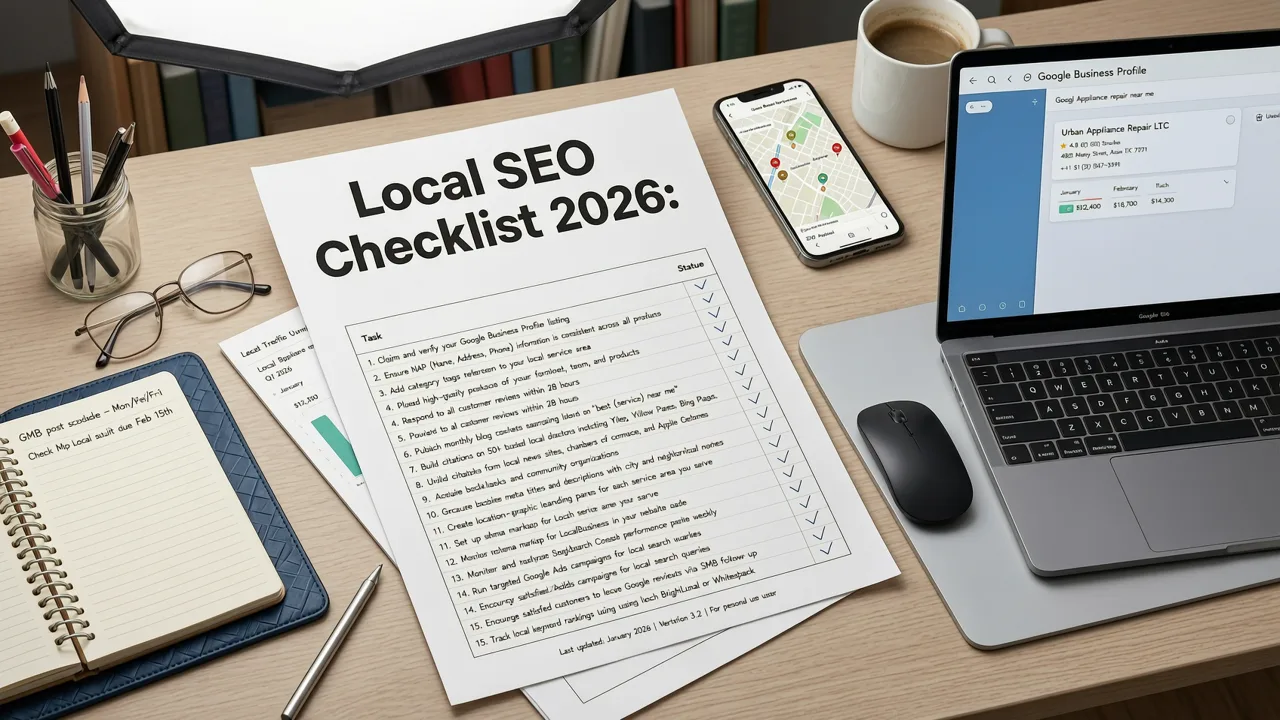
| Step | What to Do | 2026 Priority | Time Required |
|---|---|---|---|
| 1. GBP Verification | Complete video, postcard, or instant verification | Critical | 1–5 days |
| 2. GBP Optimization | Fix name/category/attributes; fill all sections | Critical | 1 hour |
| 3. NAP+W Consistency | Update top 12 directories with identical formatting | High | 2–3 hours |
| 4. Local Schema | Add valid JSON-LD LocalBusiness markup to homepage & location pages | High | 1–2 hours |
| 5. Review Management | Earn 3–5 new genuine reviews; respond to all in <48h | Medium-High | Ongoing (30 min/week) |
| 6. Local Content | Create 1 location-specific landing page (if multi-location) | Medium | 3–5 hours |
Frequently Asked Questions
Still have questions? Here are answers to the most common ones we hear from local business owners in 2026.
How often should I update my Google Business Profile in 2026?
At minimum: weekly GBP Posts, monthly review responses, and quarterly full profile audits. If you change hours, services, or ownership, update GBP immediately — delays trigger trust penalties.
Do I need a separate website for each location?
No — but you do need unique, valuable location-specific content. Subfolders (yoursite.com/austin/) or subdomains (austin.yoursite.com) work if properly structured with hreflang and local schema. Avoid duplicate content.
Can I use AI to write my local service pages?
You can use AI for drafting — but never publish without human editing. Google’s 2026 Helpful Content Update demotes AI-generated pages lacking real local expertise, firsthand experience, or customer proof. Add real project photos, local testimonials, and neighborhood references manually.
Ready to Rank Locally in 2026?
Implementing even 6 of these 12 steps will improve your local visibility — but doing all 12 creates a compounding effect that drives qualified leads consistently. Local SEO in 2026 rewards authenticity, technical precision, and sustained effort — not shortcuts.
If managing this checklist feels overwhelming — or if you’ve tried and aren’t seeing traction — our local SEO specialists can handle the heavy lifting. We build custom local strategies, manage GBP at scale, earn legitimate reviews, and track ROI transparently — all aligned with Google’s 2026 standards.
Start today: Download our free Local SEO Checklist 2026 PDF — printable, shareable, and updated quarterly.
Related resources
Frequently Asked Questions
How often should I update my Google Business Profile in 2026?
At minimum: weekly GBP Posts, monthly review responses, and quarterly full profile audits. If you change hours, services, or ownership, update GBP immediately — delays trigger trust penalties.
Do I need a separate website for each location?
No — but you do need unique, valuable location-specific content. Subfolders (yoursite.com/austin/) or subdomains (austin.yoursite.com) work if properly structured with hreflang and local schema. Avoid duplicate content.
Can I use AI to write my local service pages?
You can use AI for drafting — but never publish without human editing. Google’s 2026 Helpful Content Update demotes AI-generated pages lacking real local expertise, firsthand experience, or customer proof. Add real project photos, local testimonials, and neighborhood references manually.
What’s the #1 mistake businesses make with local SEO in 2026?
Assuming GBP optimization is a one-time task. In 2026, Google rewards freshness, responsiveness, and contextual relevance — so stale posts, unanswered reviews, and outdated hours directly suppress visibility.
Related Articles


Explore more practical SEO Services and appraisal guides.
View all articles