Local SEO Audit for Small Business: Fix What's Holding You Back (2026)
Run a local SEO audit for small business success in 2026. This step-by-step guide uncovers hidden issues in your Google Business Profile, citations, and site.

Why a Local SEO Audit for Small Business Matters More Than Ever in 2026

If your phone isn't ringing and your storefront isn't getting foot traffic, the problem almost always starts with local search. A local SEO audit for small business is the single fastest way to identify why Google is ranking your competitors above you — and exactly what to fix this week. In 2026, local pack results are more competitive than ever, AI-powered search surfaces are reshaping visibility, and even minor profile errors can cost you dozens of leads every month.
This guide walks you through a complete, no-fluff local SEO audit you can run in an afternoon. By the end, you'll have a prioritized list of fixes, a clear picture of where you're losing customers, and a roadmap to turn your Google Business Profile, website, and citations into a lead-generating machine.
What a Local SEO Audit Actually Covers
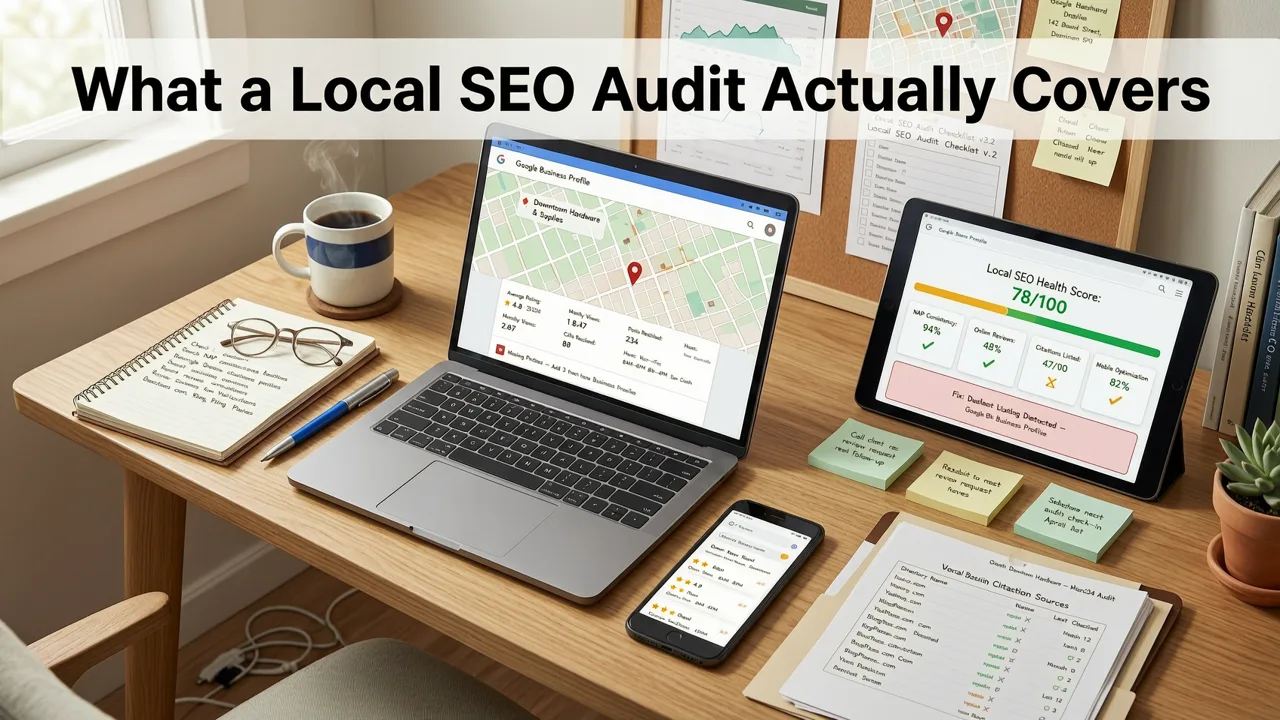
A proper local SEO audit goes far beyond checking your NAP (Name, Address, Phone). In 2026, it evaluates four interconnected layers that Google uses to rank local businesses:
- Google Business Profile (GBP) health — completeness, categories, photos, posts, and review signals.
- On-page local relevance — location pages, schema markup, title tags, and mobile experience.
- Citation consistency — NAP uniformity across directories, industry sites, and social platforms.
- Competitor and market positioning — what the top three local rivals are doing differently.
Think of it as a diagnostic scan. You wouldn't drive a car for 50,000 miles without an inspection — don't let your local presence go that long without one either.
Step 1: Audit Your Google Business Profile
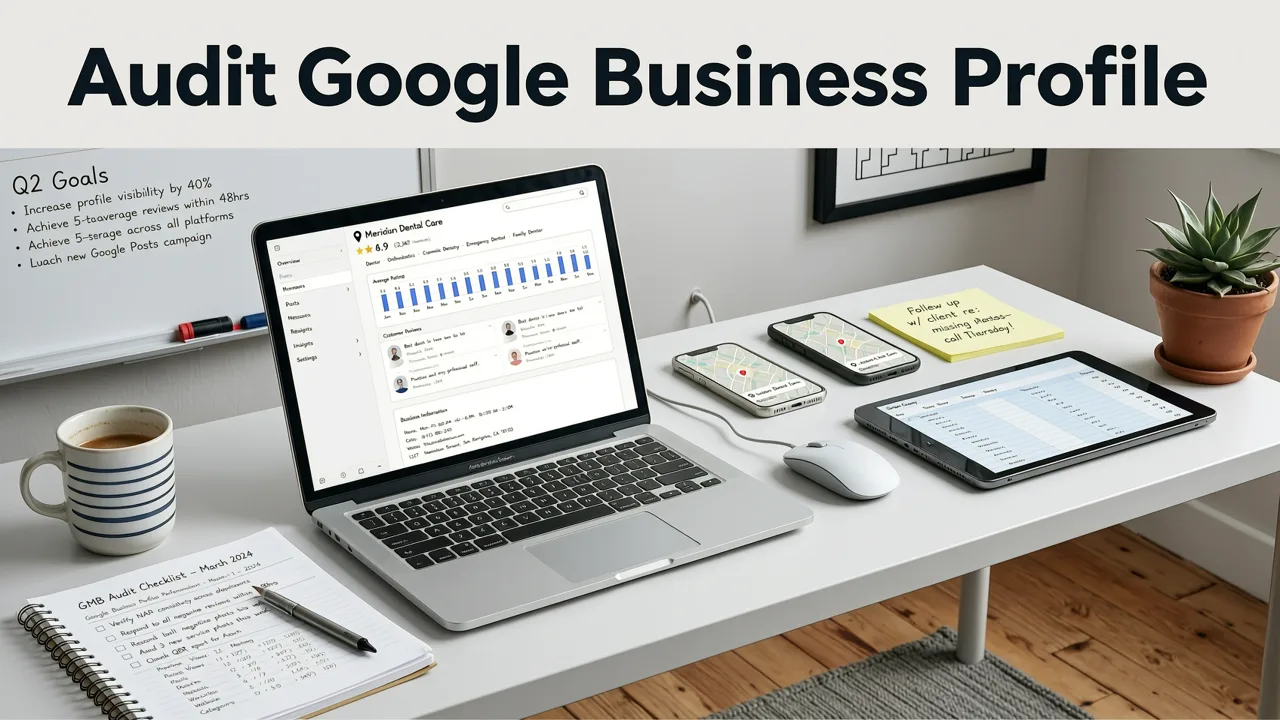
Your Google Business Profile is the single most important ranking factor in local search. Start here, because most small businesses leave significant points on the table.
Verify Core Information Is 100% Accurate
Check that your business name, address, phone number, website URL, hours, and primary category are all correct. Even small discrepancies — like "St." versus "Street" or an outdated suite number — can confuse Google's local algorithm. Make sure your business information matches Google Search Central guidelines exactly.
Confirm Your Primary and Secondary Categories
Your primary category carries the most ranking weight. If you're a plumber, "Plumber" should be primary — not "Home Services Contractor." Secondary categories should capture the other services you genuinely offer. Audit competitors in your top three local pack results and note which categories they use.
Review Photos, Posts, and Q&A
Profiles with 100+ photos significantly outperform those with fewer than 20. Audit your photo library for quality, recency, and variety — exterior, interior, team, work-in-progress, and completed projects. Check that your Q&A section has at least five commonly asked questions answered. If it doesn't, seed it yourself.
Analyze Review Quantity, Velocity, and Response Rate
Google rewards businesses that earn reviews consistently and respond to them. Calculate your average reviews per month over the last 90 days. If it's below three, you have a review-generation problem. Also check your response rate — aim to reply to 100% of reviews, positive and negative, within 48 hours.
Step 2: Audit Your Website's Local On-Page SEO
Your website needs to send clear local signals to Google. This is where many small businesses silently leak rankings.
Check Title Tags and Meta Descriptions for Local Keywords
Every important page should include your city or region in the title tag. For example: "Emergency Plumber in Austin, TX | 24/7 Service | Your Business Name." Audit your top 10 pages and confirm each has a unique, location-aware title under 60 characters and a compelling meta description under 155 characters.
Evaluate Location Pages
If you serve multiple cities, you need dedicated location pages — not just a single "Service Areas" list. Each location page should have unique content, local testimonials, embedded maps, and city-specific service details. Thin or duplicated location pages hurt more than they help.
Verify Local Business Schema Markup
Structured data helps Google understand your business. Use Schema.org's LocalBusiness types to mark up your name, address, phone, hours, price range, and service area. Run your homepage through Google's Rich Results Test and fix any errors or warnings. If you have multiple locations, each should have its own schema block.
Test Mobile Usability and Page Speed
More than 60% of local searches happen on mobile. Use Google's PageSpeed Insights and Mobile-Friendly Test to audit your core pages. A page that takes over three seconds to load is losing customers. Prioritize image compression, lazy loading, and minimal JavaScript.
Step 3: Audit Your Citation Profile
Citations are mentions of your business name, address, and phone number on other websites. Consistency is critical.
Run a NAP Consistency Check
Use a citation audit tool to scan the top 50 directories for your business. Look for variations like "123 Main St." on one site and "123 Main Street, Suite 4" on another. Even small differences dilute your local ranking signal. Document every inconsistency and fix them in priority order — start with Apple Maps, Bing Places, Facebook, Yelp, and industry-specific directories.
Identify Missing Citation Opportunities
Compare your citation footprint against your top three local competitors. If they're listed on directories where you're absent, add those. Focus on high-authority, relevant platforms — not low-quality web directories that provide no real value.
Step 4: Audit Your Local Content and Link Profile
Local content and local backlinks work together to build topical authority in your market.
Review Your Local Content Output
Are you publishing content that speaks to your local audience? Community guides, local event sponsorships, neighborhood-specific service pages, and case studies featuring local clients all send strong relevance signals. If your blog hasn't been updated in six months, that's an audit finding in itself.
Analyze Local Backlinks
Use a backlink tool to identify which local websites link to you — chambers of commerce, local news outlets, sponsorships, community organizations. Compare against competitors. If they have 15 local backlinks and you have three, you know where to focus your outreach. For deeper guidance, our keyword research guide for beginners covers how to find local content opportunities that attract links.
Step 5: Benchmark Against Local Competitors
Your audit isn't complete until you understand what the businesses ranking above you are doing differently.
Map the Local Pack Top 3
Search your primary service + city and document the top three results. Note their review count, star rating, photo count, years in business, website quality, and any visible differentiators. This isn't about copying them — it's about understanding the competitive threshold you need to meet or exceed.
Identify Your Competitive Gaps
Create a simple comparison. If the average top-three competitor has 85 reviews and you have 22, review generation is your priority. If they all have dedicated location pages and you don't, that's your next project. Use these insights to build a 90-day action plan.
The Complete Local SEO Audit Checklist
Use this table as your working checklist. Score each item as Pass, Needs Work, or Fail, then prioritize fixes by impact.
| Audit Area | Key Check | Status |
|---|---|---|
| Google Business Profile | All fields complete, accurate, and optimized | — |
| Primary Category | Matches your core service exactly | — |
| Photos | 100+ high-quality, recent images | — |
| Reviews | 3+ new reviews per month, 100% response rate | — |
| Title Tags | Include city + primary service on key pages | — |
| Location Pages | Unique, detailed pages for each service area | — |
| Schema Markup | LocalBusiness schema validated, no errors | — |
| Mobile Speed | Core pages load under 3 seconds on mobile | — |
| NAP Consistency | Identical across top 50 directories | — |
| Local Backlinks | At least 10 quality local referring domains | — |
| Local Content | Published within the last 60 days | — |
| Competitor Gap | Documented and prioritized action plan | — |
How Often Should You Run a Local SEO Audit?
For most small businesses, a full audit every quarter is ideal, with lightweight monthly check-ins on reviews, GBP posts, and new citations. Google's local algorithm evolves constantly, and your competitors aren't standing still. If you've recently moved, changed your phone number, expanded services, or noticed a traffic drop, run an audit immediately.
For a structured approach to ongoing optimization, our local SEO checklist for small business breaks down the monthly, quarterly, and annual tasks you need to stay ahead.
When to Bring in an SEO Agency
Not every business owner has the time or expertise to run a deep local SEO audit and execute the fixes. If your audit reveals significant gaps — broken schema, inconsistent citations across hundreds of directories, no location pages, or a review deficit of 50+ compared to competitors — it may be time to partner with a professional. Understanding SEO agency pricing in 2026 will help you budget smartly and avoid overpaying for services you don't need.
A good agency will run the audit for you, prioritize the highest-impact fixes, and build an ongoing optimization plan. The ROI of local SEO is among the highest in digital marketing — every ranking improvement in the local pack directly translates to phone calls, directions requests, and foot traffic.
Your Next Steps After the Audit
An audit without action is just a report. Here's how to turn findings into results:
- Fix critical errors first. Incorrect NAP, broken schema, and an unverified GBP are emergencies. Handle them this week.
- Close the biggest competitive gaps. If reviews are your weakest area, launch a review-generation campaign immediately.
- Build your 90-day plan. Assign each audit finding to a team member with a deadline. Track progress weekly.
- Schedule your next audit. Put it on the calendar for 90 days from now. Consistency is what separates businesses that grow from businesses that stagnate.
For a comprehensive step-by-step framework, explore our Local SEO Checklist 2026 with 12 actionable steps to keep your momentum going long after the audit is done.
Final Thoughts
A local SEO audit for small business isn't a one-time task — it's the foundation of sustainable local growth. The businesses that win in 2026 aren't necessarily the biggest or the oldest. They're the ones that show up correctly, consistently, and compellingly every time a potential customer searches. Run the audit, fix what's broken, and watch your local presence transform.
Ready to go deeper? Start with our complete Local SEO Checklist for Small Business (2026 Edition) and turn today's audit findings into tomorrow's rankings.
Frequently Asked Questions
How long does a local SEO audit take for a small business?
A thorough local SEO audit for a small business typically takes 2 to 4 hours if you're doing it manually. This includes reviewing your Google Business Profile, checking on-page SEO elements, running a citation consistency scan, and benchmarking against local competitors. Agencies can often complete the same audit in 30 to 60 minutes using specialized tools.
What is the most important factor in a local SEO audit?
Your Google Business Profile is the single most important factor. It directly influences your local pack rankings, map visibility, and the information customers see before they even visit your website. A complete, accurate, and actively managed GBP outperforms almost any other single optimization in local search.
How often should a small business run a local SEO audit?
We recommend a full local SEO audit every quarter, with lightweight monthly check-ins on reviews, GBP posts, and citation accuracy. If you've recently moved locations, changed your phone number, or noticed a drop in calls or foot traffic, run an audit immediately regardless of your regular schedule.
Can I run a local SEO audit myself or do I need an agency?
You can absolutely run a local SEO audit yourself using free tools like Google Business Profile, Google Search Console, and PageSpeed Insights. However, if your audit reveals complex issues like widespread citation inconsistencies, broken schema across multiple locations, or a significant competitive gap, partnering with an experienced local SEO agency can accelerate your results.
What are the most common issues found in a local SEO audit?
The most common issues include inconsistent NAP data across directories, incomplete or unoptimized Google Business Profile fields, missing or broken local schema markup, lack of dedicated location pages for multi-area businesses, slow mobile page speed, and fewer reviews than local competitors. Addressing even two or three of these can produce measurable ranking improvements within 60 to 90 days.
Related Articles


Explore more practical SEO Services and appraisal guides.
View all articles