How to Do an SEO Audit Step by Step (2026 Guide)
Learn how to do an SEO audit step by step in 2026. This practical guide covers technical, on-page, content, and off-page checks to boost rankings and traffic.

Why an SEO Audit in 2026 Looks Different Than It Used To

If you're trying to figure out how to do an SEO audit step by step in 2026, the short answer is: crawl your site, fix what's broken, align content with real user intent, and validate everything with structured data. The longer answer is that Google's ranking systems now blend AI-driven answer engines, core web vitals thresholds, and entity-based understanding into a single evaluation. An audit that skips any of those layers will miss the issues holding your traffic back.
A proper SEO audit is the diagnostic foundation for every campaign. It tells you exactly where your site is leaking rankings, where your content is thin, and where your technical setup is silently blocking crawlers. Whether you run a local service business, a SaaS platform, or a national e-commerce brand, this step-by-step guide gives you the workflow to audit like a senior SEO strategist.
What an SEO Audit Actually Covers in 2026

Before we walk through the steps, it helps to understand what a modern audit evaluates. Google's algorithms in 2026 reward sites that deliver fast, accessible, trustworthy, and intent-matched experiences. Your audit needs to mirror that evaluation across five core pillars:
- Technical SEO: crawlability, indexation, site speed, mobile rendering, and structured data.
- On-Page SEO: title tags, meta descriptions, heading hierarchy, internal linking, and URL structure.
- Content Quality: topical depth, freshness, E-E-A-T signals, and alignment with search intent.
- Off-Page SEO: backlink profile health, referring domain diversity, and brand mention signals.
- Local SEO (if applicable): Google Business Profile accuracy, citation consistency, and local relevance.
Each pillar has its own checklist, but they all feed into a single prioritized action plan. Let's walk through the process.
Step 1: Define Your Audit Goals and Baseline Metrics
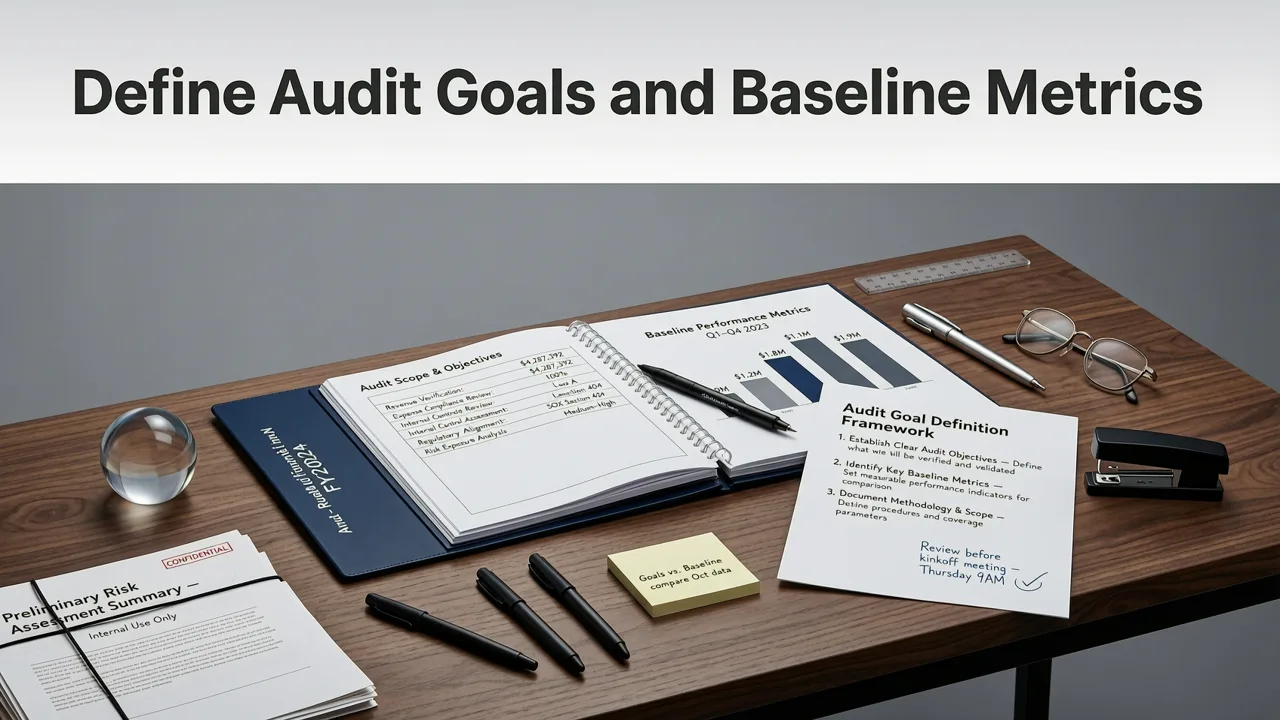
Every audit starts with context. Before you open a single tool, write down what you're trying to achieve and where you stand today.
Set Clear Objectives
Are you trying to recover lost traffic? Prepare for a site migration? Scale organic leads for a new product line? Your goals determine which areas of the audit deserve the most attention. A local bakery recovering from a traffic drop needs a different priority stack than a B2B SaaS company expanding into a new keyword cluster.
Capture Baseline Data
Pull current performance numbers from Google Search Console and your analytics platform. Record:
- Total organic sessions and conversions (last 90 days)
- Top 20 ranking keywords and their current positions
- Core Web Vitals scores for mobile and desktop
- Total indexed pages versus total discovered pages
- Referring domain count and toxic link flags
This snapshot becomes your before-and-after benchmark. Without it, you can't measure whether your fixes actually moved the needle.
Step 2: Crawl Your Site and Map the Indexation Landscape
The crawl is the heartbeat of any technical audit. If Googlebot can't reach or parse your pages, nothing else matters.
Run a Full Site Crawl
Use a crawling tool to capture every URL on your domain. Pay close attention to:
- Status codes: 404 errors, redirect chains, and soft 404s waste crawl budget and dilute link equity.
- Canonical tags: verify that each page points to its correct canonical version.
- Robots.txt and meta robots: confirm you're not accidentally blocking critical resources or pages.
- XML sitemap accuracy: your sitemap should only include live, 200-status URLs you want indexed.
Compare Crawled URLs Against Indexed URLs
Cross-reference your crawl data with the Coverage report in Google Search Console. If you have 5,000 URLs in your sitemap but only 3,200 indexed, you need to find out why the remaining 1,800 are excluded. Common culprits include thin content, duplicate pages, and crawl errors documented in the Google Search Central documentation.
Step 3: Audit Technical SEO Foundations
Technical SEO is the infrastructure layer. Weak foundations cause rankings to plateau no matter how strong your content is.
Core Web Vitals and Page Speed
Google's 2026 thresholds continue to prioritize user experience. Check Largest Contentful Paint (LCP), Interaction to Next Paint (INP), and Cumulative Layout Shift (CLS) across your top traffic pages. Pages that fail these metrics on mobile will struggle to rank for competitive queries.
Mobile Rendering and JavaScript Execution
Render your key pages through a mobile emulator and compare the rendered DOM against the raw HTML. If critical content only appears after JavaScript execution, you risk incomplete indexing. Ensure your most important content is present in the initial server response.
HTTPS and Security
Verify that every page loads over HTTPS, that your SSL certificate is valid, and that there are no mixed-content warnings. Security remains a baseline ranking requirement.
Structured Data Validation
Structured data helps search engines understand your content's context. Audit your schema markup against the Schema.org reference and validate it with Google's Rich Results Test. Common issues include missing required fields, mismatched types, and orphaned markup on deleted pages.
Step 4: Evaluate On-Page SEO Elements
On-page optimization is where your keyword strategy meets the page. Every element should communicate relevance to both users and crawlers.
Title Tags and Meta Descriptions
Audit every title tag for length (50 to 60 characters), keyword placement, and uniqueness. Meta descriptions should be compelling, between 140 and 160 characters, and include a clear call to action. Duplicate titles across multiple pages are one of the most common — and most damaging — on-page issues.
Heading Hierarchy
Each page should have a single H1 that reflects the primary topic. H2 and H3 tags should break the content into logical, scannable sections. Missing or nested heading structures confuse crawlers about what your page is actually about.
Internal Linking Architecture
Map your internal links to identify orphan pages, link equity distribution, and anchor text diversity. Strong internal linking passes authority from high-traffic pages to important but underperforming ones. If you're building out new topic clusters, a solid internal linking plan is essential.
URL Structure
Clean, descriptive URLs help both users and search engines. Avoid long query strings, unnecessary parameters, and URLs that reveal your CMS architecture. A URL like /blog/seo/how-to-do-an-seo-audit-step-by-step is far more effective than /page?id=4829.
Step 5: Audit Content Quality and Search Intent Alignment
Content quality is the single biggest differentiator in 2026. Google's systems now evaluate topical depth, originality, and first-hand experience far more aggressively than in previous years.
Identify Thin and Duplicate Content
Flag pages with fewer than 300 words of substantive content, pages that duplicate other URLs on your site, and pages that offer no unique value. Thin content drains your overall site quality score. Either consolidate, expand, or noindex these pages.
Match Content to Search Intent
For each target keyword, analyze the current SERP. Are the top results long-form guides, product pages, comparison tables, or local listings? If your page format doesn't match the dominant intent, no amount of on-page tweaking will close the gap. This is where understanding how to do keyword research for beginners pays off, because intent mapping starts at the research stage.
Refresh and Update Evergreen Content
Pages published two or more years ago often lose rankings simply because competitors have published fresher, more comprehensive versions. Audit your top-performing content and update statistics, add new sections, embed current media, and republish with the current year in the title where appropriate.
E-E-A-T Signals
Review author bylines, credential pages, and about sections. Google rewards content that demonstrates Experience, Expertise, Authoritativeness, and Trustworthiness. Make sure every piece of content clearly attributes a qualified author and links to supporting credentials.
Step 6: Analyze Your Backlink Profile
Your off-page profile determines how much authority search engines assign to your domain. A healthy backlink audit looks at both quality and risk.
Assess Referring Domain Diversity
A site with 500 links from 50 domains is weaker than a site with 200 links from 180 domains. Evaluate the diversity of your referring domains by industry, geography, and domain authority.
Identify Toxic Links
Look for links from link farms, irrelevant directories, and spammy anchor text distributions. Compile a disavow file for any patterns that could trigger algorithmic or manual penalties.
Find Link Building Opportunities
Compare your backlink profile against your top competitors. Identify domains that link to them but not to you. These represent realistic outreach targets, especially if the linking context is relevant to your niche.
Step 7: Check Local SEO Signals (If Applicable)
For businesses with a physical presence or service area, local SEO is a critical audit pillar. If you operate in a specific geographic market, follow the detailed steps in the Local SEO Checklist 2026 to ensure every signal is aligned.
Google Business Profile Accuracy
Verify that your business name, address, phone number, hours, and categories are 100% accurate. Inconsistencies between your GBP and your website citations confuse Google's local ranking systems.
Review Quantity and Quality
Audit your review count, average rating, and response rate. Responding to every review — positive and negative — signals active engagement and improves local trust signals.
Local Citation Consistency
Check major directories and industry-specific listings for NAP (Name, Address, Phone) consistency. Even small variations like "St." versus "Street" can fragment your local relevance.
Step 8: Build Your Prioritized Action Plan
An audit without an action plan is just a report. The final step is to translate every finding into a prioritized task list.
Rank Issues by Impact and Effort
Use a simple impact-versus-effort matrix to decide what to fix first. Critical technical issues that block indexing always come first. Then move to high-impact content updates, followed by on-page refinements and link building initiatives.
Assign Ownership and Timelines
Every task should have an owner and a deadline. If you're working with an agency, review the SEO agency pricing guide to understand what level of support fits your budget and scope.
| Audit Area | Key Checks | Priority Level | Typical Fix Time |
|---|---|---|---|
| Technical SEO | Crawl errors, Core Web Vitals, structured data | Critical | 1–3 weeks |
| On-Page SEO | Title tags, headings, internal links | High | 1–2 weeks |
| Content Quality | Thin content, intent match, E-E-A-T | High | 2–6 weeks |
| Backlink Profile | Toxic links, referring domain diversity | Medium | Ongoing |
| Local SEO | GBP accuracy, citations, reviews | Medium (local businesses) | 1–2 weeks |
Step 9: Schedule Recurring Audits
SEO is not a one-time project. Algorithms change, competitors publish new content, and your site grows. Schedule a full audit every quarter and a lightweight technical check every month. This cadence ensures you catch regressions early and stay ahead of algorithm updates.
Common SEO Audit Mistakes to Avoid in 2026
Even experienced marketers fall into traps that weaken their audits. Watch out for these:
- Auditing without goals: A checklist without context leads to random fixes that don't move business metrics.
- Ignoring mobile performance: Desktop-only audits miss the majority of user behavior in 2026.
- Overlooking structured data: Rich results drive significant click-through rate improvements but are often skipped in basic audits.
- Treating content as a checkbox: Updating a meta description is not a content strategy. Depth, originality, and experience matter more than ever.
- Skipping the re-audit: Fixing issues without verifying the fix is how problems resurface months later.
Frequently Asked Questions
How long does an SEO audit take?
A thorough SEO audit for a mid-sized website typically takes two to four weeks, depending on site size and complexity. Small local sites may be completed in under a week, while enterprise properties with thousands of URLs can take six weeks or more.
How often should I perform an SEO audit?
Plan a comprehensive audit every quarter and a lightweight technical review monthly. If you undergo a major site migration, redesign, or algorithm update, run an additional audit immediately afterward.
What tools do I need for an SEO audit?
At minimum, you need Google Search Console, Google Analytics, a crawling tool such as Screaming Frog or Lumar, a page speed testing tool, and a backlink analysis platform. Many agencies bundle these into a managed audit service.
Can I do an SEO audit myself or should I hire an agency?
You can run a basic audit yourself using free tools, but a professional audit from an experienced agency uncovers deeper technical and strategic issues. If you're evaluating costs, the SEO agency pricing guide breaks down what to expect across different service levels.
What is the most important part of an SEO audit?
The most important part is translating findings into a prioritized action plan. An audit that identifies problems but doesn't drive fixes has zero impact on rankings or revenue.
Start Your SEO Audit Today
Knowing how to do an SEO audit step by step gives you a clear roadmap to diagnose what's holding your site back and prioritize the fixes that will move the needle. From technical crawl health to content depth and local signals, every layer of your audit feeds into a stronger, more resilient organic strategy.
If you'd rather have an experienced team handle the audit and build the action plan for you, reach out to our SEO strategists. We'll crawl your site, identify your highest-impact opportunities, and deliver a roadmap you can act on immediately.
Frequently Asked Questions
How long does an SEO audit take?
A thorough SEO audit for a mid-sized website typically takes two to four weeks, depending on site size and complexity. Small local sites may be completed in under a week, while enterprise properties with thousands of URLs can take six weeks or more.
How often should I perform an SEO audit?
Plan a comprehensive audit every quarter and a lightweight technical review monthly. If you undergo a major site migration, redesign, or algorithm update, run an additional audit immediately afterward.
What tools do I need for an SEO audit?
At minimum, you need Google Search Console, Google Analytics, a crawling tool such as Screaming Frog or Lumar, a page speed testing tool, and a backlink analysis platform. Many agencies bundle these into a managed audit service.
Can I do an SEO audit myself or should I hire an agency?
You can run a basic audit yourself using free tools, but a professional audit from an experienced agency uncovers deeper technical and strategic issues. An agency also provides prioritized recommendations and ongoing support to implement fixes.
What is the most important part of an SEO audit?
The most important part is translating findings into a prioritized action plan. An audit that identifies problems but doesn't drive fixes has zero impact on rankings or revenue.
Related Articles


Explore more practical SEO Services and appraisal guides.
View all articles