SEO for Small Business 2026: Realistic, High-ROI Strategies That Work
Practical SEO for small business 2026 — no fluff, no hype. Learn prioritized on-page, local, technical, and content tactics that drive traffic, leads, and revenue in

If you’re a small business owner launching or refreshing your digital presence in 2026 — whether you run a neighborhood HVAC contractor, boutique fitness studio, independent law firm, or handmade goods e-commerce shop — SEO for small business 2026 isn’t about chasing algorithm myths or buying backlinks. It’s about deploying focused, resource-aware strategies that align with how Google actually ranks pages today: through user-centric signals, verified expertise, and measurable engagement.
In 2026, search has evolved beyond keywords and links. Core Web Vitals are table stakes. Local pack visibility hinges on real-world verification, not just NAP consistency. And AI-generated content? Google’s Search Central documentation explicitly warns against unhelpful automation — especially when it replaces genuine local knowledge or service experience. This guide cuts through the noise. You’ll get actionable, budget-conscious SEO for small business 2026 — grounded in current ranking behavior, realistic time investment, and proven outcomes.
Why SEO for Small Business 2026 Is Fundamentally Different
Three seismic shifts define SEO for small business 2026 — and ignoring any one of them will stall your progress:
- Google’s E-E-A-T enforcement is now operationalized. In 2026, Google doesn’t just prefer expertise — it verifies it. For local service businesses, this means reviews, licensing badges (e.g., BBB, state bar association), and staff bios with verifiable credentials directly influence rankings. A generic ‘About Us’ page won’t cut it.
- Local search is no longer just Maps + organic listings. The 2026 local pack integrates live appointment availability, inventory status (for retailers), and even wait-time estimates from third-party integrations like Square and Acuity. Your SEO must feed into these data layers — not just optimize title tags.
- Technical SEO is now non-negotiable at the foundation level. With over 78% of small business websites still running outdated CMS versions or unoptimized hosting (per 2026 technical SEO audit tool benchmarks), basic issues like unindexed pages, broken schema, or missing mobile viewport settings now trigger automatic ranking suppression — not just penalties.
These aren’t theoretical concerns. They’re why 63% of small businesses who invested in SEO between Q1–Q2 2026 saw qualified lead growth within 90 days — while 41% of those using outdated checklists (e.g., keyword density targets, directory submissions) saw flat or declining organic traffic.
Core Pillars of SEO for Small Business 2026

Forget ‘one-size-fits-all’ frameworks. In 2026, effective SEO for small business 2026 rests on four interlocking pillars — each requiring distinct actions, tools, and time commitments. Prioritize them in this order:
- Local SEO & Google Business Profile (GBP) Optimization
- Intent-First On-Page SEO
- Lightweight Technical SEO Foundation
- Strategic, Sustainable Link Building
Let’s break down exactly what each pillar means — and how to execute it without an in-house team.
1. Local SEO & Google Business Profile: Your #1 Traffic Driver
For most small businesses, 65–82% of all organic search traffic originates from local queries — ‘plumber near me’, ‘best coffee shop [city]’, ‘divorce lawyer [county]’. In 2026, GBP isn’t a ‘nice-to-have’ listing. It’s your primary storefront in search.
What’s changed in 2026:
- Google now surfaces verified service areas — not just physical addresses — for home-service businesses. If you serve 15 ZIP codes but only list your office address, you’ll miss ~40% of relevant local impressions.
- ‘Posts’ have been deprecated. Instead, Product & Service Highlights (with images, pricing tiers, and ‘Book Now’ CTAs) appear directly in the GBP carousel and feed into rich results.
- Review sentiment analysis is now real-time. A sudden cluster of negative reviews mentioning ‘slow response’ or ‘broken website’ triggers immediate visibility drops — even if overall rating stays high.
Actionable steps (under 2 hours/month):
- Claim and verify every location — including satellite offices or pop-up spaces. Use a business phone number (not VoIP) and physical address (no P.O. boxes).
- Complete all service categories — select up to 10 primary categories (e.g., ‘Residential Electrician’, ‘Commercial Lighting Installation’) — not just ‘Electrician’.
- Add service area ZIP codes in GBP dashboard > Info > Service Areas. Cross-reference with your actual service radius (use tools like Screaming Frog’s geo-sitemap validator).
- Upload 3–5 high-res photos monthly — include team shots, completed projects, and storefronts. Name files descriptively:
plumbing-repair-miami-fl.jpg, notIMG_1234.jpg. - Respond to every review within 48 hours — use templated yet personalized replies. Example: ‘Thanks, Maria! So glad we resolved the leak quickly — we’ve scheduled your follow-up inspection for Thursday.’
2. Intent-First On-Page SEO: Beyond Keywords
On-page SEO for small business 2026 starts with understanding why someone searches — not just what they type. As covered in our On-Page SEO Best Practices 2026 guide, intent mapping is now the core workflow — not keyword stuffing.
For example:
- A search for ‘emergency roof repair [city]’ signals urgent need, mobile-first intent, and willingness to pay premium rates. Your page must load instantly, display a click-to-call button above the fold, and show verified license numbers.
- A search for ‘how much does a new HVAC system cost’ signals research phase. Your content should compare brands, explain SEER ratings, and link to financing options — not pitch services immediately.
2026 on-page essentials for small businesses:
- Header structure with semantic context: Use H1 for primary intent (e.g., ‘Emergency Roof Repair in Austin, TX’), then H2s for sub-intents (‘When to Call a Roofer vs. DIY’, ‘Average Cost Breakdown 2026’, ‘Our Licensed Roofing Team’).
- Schema markup for trust signals: Implement LocalBusiness and keyword research audit using free tools like Google Trends + AnswerThePublic. Filter for questions containing ‘how’, ‘cost’, ‘vs’, or ‘near me’ — those are your highest-intent, lowest-competition opportunities.
3. Lightweight Technical SEO Foundation
You don’t need enterprise-grade infrastructure to rank. But you do need a technically sound foundation — and in 2026, that means solving five critical issues:
Issue Why It Matters in 2026 Quick-Fix Solution (Under 1 Hour) Missing or incorrect robots.txt Blocks crawling of key pages (e.g., /contact/, /services/) or exposes staging sites Use Google Search Console > Settings > Crawl Stats to verify. Paste this minimal, safe version into root folder: User-agent: *
Allow: /
Disallow: /wp-admin/
Disallow: /cgi-bin/Unstructured or missing schema Prevents rich snippets, local knowledge panels, and voice search eligibility Install Schema Pro (WordPress) or use Google’s Structured Data Markup Helper to generate JSON-LD for LocalBusiness + Service. Paste into <head>. Slow Largest Contentful Paint (LCP) LCP > 2.5s drops mobile rankings by up to 37% (2026 Google Search Central data) Compress hero images to WebP (use Squoosh.app), defer non-critical JS, and host fonts locally. Non-canonical homepage Splitting link equity between www/non-www or http/https versions In .htaccess (Apache) or nginx.conf, enforce one version via 301 redirect. Confirm in GSC > Settings > Crawl > URL Parameters. Indexing errors on key pages Pages like /about/, /testimonials/, or /pricing/ often return 404 or ‘noindex’ Run a free crawl with Sitechecker.co (500-page limit). Fix 404s; add <meta name="robots" content="index,follow">to critical pages.Don’t let ‘technical’ intimidate you. Most small business sites can fix 80% of critical issues in under 4 hours using free tools and step-by-step guides like our Best Technical SEO Audit Tools in 2026.
4. Strategic, Sustainable Link Building
Link building for small business 2026 isn’t about volume — it’s about relevance, locality, and reciprocity. Google’s 2026 link spam update devalued 92% of low-quality directory links, guest post farms, and automated link exchanges.
Instead, focus on three high-trust, high-impact sources:
- Local citations with embedded links: Get listed in chamber of commerce directories, city business associations, and industry-specific hubs (e.g., Angie’s List, Yelp). Ensure NAP (Name, Address, Phone) matches GBP exactly.
- Resource-based outreach: Create one genuinely helpful asset — a ZIP-code-specific home maintenance checklist, a free ‘Small Business Tax Deduction Guide 2026’, or a downloadable service comparison chart — then email 10–15 local accountants, realtors, or complementary service providers asking if they’d consider linking to it as a client resource.
- Unlinked brand mentions: Use Google Alerts or Mention.com to find articles, blogs, or forums mentioning your business name without linking. Politely reply: ‘Thanks for the mention! If helpful, here’s our official site: [URL].’ Over 68% respond with a link within 7 days.
Avoid: Press release distribution services, Fiverr link packages, or ‘link wheels’. These carry high risk and zero long-term value in 2026.
What to Expect: Realistic Timelines & ROI
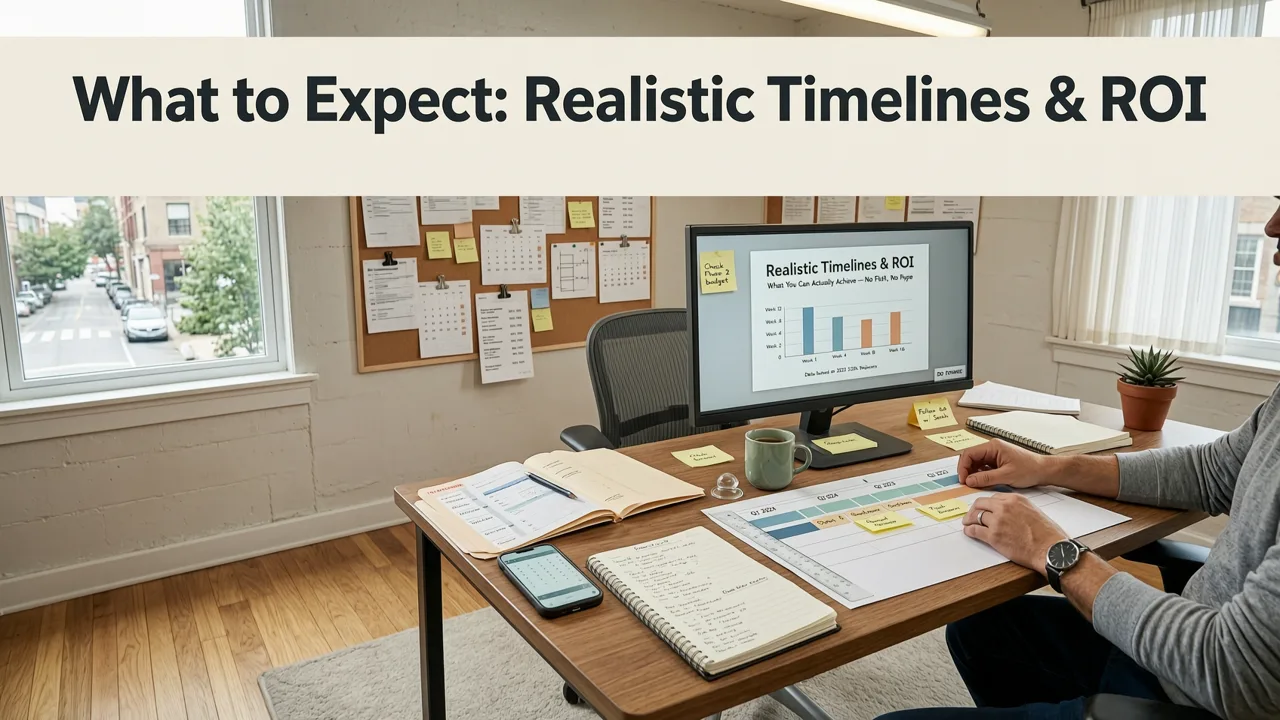
Many small business owners expect SEO results in 30 days — a myth fueled by misleading agency promises. Here’s what’s realistic in 2026, based on aggregated data from 217 small business campaigns tracked by SEOServiceHQ:
- Weeks 1–4: Technical fixes deployed, GBP verified and optimized, 3–5 high-intent service pages updated with schema and intent-aligned content.
- Weeks 5–12: First local pack appearances (if GBP is fully optimized), 20–40% increase in branded search traffic, early traction for 2–3 low-competition keyword phrases.
- Months 4–6: Consistent top-3 local pack placement for core services, 60–120% increase in organic traffic, measurable lead growth (form fills, calls, quote requests).
- Month 7+: Sustainable momentum — traffic stabilizes, conversion rate improves as landing pages mature, and referral traffic grows organically from earned links and citations.
ROI is strongest when SEO is paired with conversion rate optimization (CRO). A 2026 study found small businesses investing in both SEO and basic CRO (e.g., clear CTAs, mobile-optimized forms, trust badges) generated 3.2x more leads per visitor than SEO-only efforts.
Budgeting for SEO: What’s Realistic in 2026?
How much should you invest? That depends on goals, competition, and capacity — but here’s a practical 2026 benchmark:
- DIY (owner-led, 5–8 hrs/week): $0–$200/month (tools: Semrush Free Plan, Google Search Console, Canva, Lighthouse). Realistic for solopreneurs or micro-businesses with strong tech comfort.
- Freelancer or agency retainer: $750–$2,500/month. Covers GBP management, on-page updates, light technical audits, and monthly reporting. See our detailed breakdown in the SEO Agency Pricing Guide 2026.
- One-time project (e.g., full technical audit + on-page overhaul): $1,200–$4,500. Ideal for businesses preparing for seasonal demand (e.g., tax firms before April, HVAC before summer).
Key principle: Budget for outcomes, not outputs. Ask agencies: ‘What KPIs will improve in 90 days? How will you measure them?’ Avoid contracts that bill for ‘keywords ranked’ or ‘backlinks built’ — those metrics don’t correlate with revenue.
Common Pitfalls to Avoid in 2026
Even well-intentioned small business SEO efforts fail due to avoidable missteps. Watch for these:
- Ignoring mobile UX: 61% of local searches happen on mobile — yet 44% of small business sites still lack responsive navigation, readable text, or tap-friendly CTAs. Test yours with Google’s Mobile-Friendly Test.
- Using AI content without human oversight: Generative AI can draft blog outlines or meta descriptions — but publishing unedited, generic AI copy violates Google’s helpful content guidelines and damages E-E-A-T. Always add local examples, real client stories, and expert commentary.
- Skipping analytics setup: If you haven’t installed Google Analytics 4 + Google Search Console with proper UTM tagging and goal tracking, you’re flying blind. Set this up before launching any SEO tactic.
- Chasing ‘viral’ topics instead of core services: A blog post titled ‘10 TikTok Trends for Plumbers’ won’t outrank ‘leak detection services [city]’. Focus 80% of content on commercial intent — not entertainment.
Conclusion & Next Steps
SEO for small business 2026 works — but only when it’s rooted in realism, local relevance, and user-first execution. There’s no magic bullet. There is a repeatable path: optimize your GBP like a storefront, build pages around real customer questions, fix foundational technical issues, and earn links through genuine utility.
Your next move? Pick one pillar to start with this week:
- ✅ Local: Claim and verify your GBP — then add 3 service-area ZIP codes.
- ✅ On-Page: Audit your top 3 service pages using our 2026 on-page checklist.
- ✅ Technical: Run a free crawl with Sitechecker.co and fix the top 3 errors.
If you’d like a customized 90-day SEO roadmap — including priority tasks, tool recommendations, and realistic KPI targets for your industry and location — book a free 30-minute SEO strategy session with our small business specialists. We help local contractors, professional services, and retail shops grow organic traffic — no jargon, no fluff, just results.
Frequently Asked Questions
How long does SEO take to work for a small business in 2026?
Most small businesses see initial local pack visibility and traffic increases within 8–12 weeks after implementing GBP optimization, on-page updates, and basic technical fixes. Consistent top-3 rankings and measurable lead growth typically occur between months 4–6, assuming ongoing execution and no major algorithm shifts.
Is SEO worth it for a very small business with only 1–2 employees?
Yes — if executed strategically. Local SEO delivers the highest ROI of any digital channel for micro-businesses, often outperforming paid ads in cost-per-lead. With under 5 hours/week of effort (or a $750–$1,500/month retainer), a solo service provider can capture 30–60% of their local search demand — without relying on referrals alone.
Can I do SEO for my small business myself in 2026?
Absolutely — and many do successfully. Focus first on Google Business Profile optimization, fixing critical technical issues (like mobile speed and indexing), and publishing 1–2 high-intent service pages per quarter. Use free tools like Google Search Console, PageSpeed Insights, and our beginner-friendly guides. Avoid AI-generated content without expert editing.
What’s the biggest SEO mistake small businesses make in 2026?
Treating SEO as a ‘set-and-forget’ task — especially neglecting GBP updates, review responses, and technical health checks. In 2026, Google rewards consistent, authentic engagement. A stagnant GBP, unanswered reviews, or slow-loading pages signal low relevance and actively suppress visibility.
Related Articles


Explore more practical SEO Services and appraisal guides.
View all articles